Sunday, Feb. 12
We just returned from the airport where we picked up Keir from his four-day excursion to Kiev, Ukraine. His Knowledge Bowl team placed first out of ten teams from such cities as Moscow and Sofia at the final tournament of the Central and Eastern European Schools Association. What’s particularly surprising is that of the four members on his team, two – Keir and his classmate Rachel -- were students of an exceptional elementary school teacher, Susan Kaplan, at Mantua Elementary School in Fairfax. Eight years after being in her class, Keir and Rachel have done her proud halfway around the world. Beyond that, Keir has just chalked up a rare experience we never could have imagined for him little more than a year and a half ago – exploring the Ukrainian underground city, playing pool in an Irish pub in Kiev, crossing the wide Dnieper River on a bridge he described as very “Soviet.” An adventure to remember.
 |
| Museum |
 |
| Keir was in the green part |
I wrote the following blog on Wednesday, and let Jim know that, as usual, his challenge would be to illustrate it. He groaned. Yesterday, he and I went to the Natural History Museum for the first time – an ornate, spectacular building in which the typical Vienna dilemma is pronounced: To look at the exhibits or the gorgeous details of the building in which they’re displayed? As we wandered through the exhibits from the primates to the unicellular organisms (we went through the exhibits backwards) and then the dinosaurs to hominids, it struck me. It’s all a story of adaptation. Those organisms that adapt survive. So, Jim’s museum photos will be strewn about the blog. The connection, I hope, will be obvious.
Wednesday, Feb. 8
Here in Vienna, on a bitter cold day, I’m taking a break from laundry. Ordinarily, that would hardly be worth mentioning, but our washing machine is broken and we’re renters and two weeks ago when we had no heat or hot water, it took three days to get it fixed, and Keir is flying to Kiev, Ukraine, tomorrow, and needs four days worth of clean clothes. Consequently, I’ve spent the last hour hand washing jeans, pants and underwear in the bidet and bathtub and figuring out places to hang them in this dryer-less apartment where they will have half a chance to dry before Keir heads to the airport. For the record, Jim usually does the laundry, but I’m the one home today.
 |
| Electric dryer |
Although the above might sound like whining, it isn’t. I’m grateful. Today’s expat themes: adaptability and the joys of physical labor.
 Washing clothes by hand feels honest. It’s an endeavor I heartily recommend all of the millionaires and billionaires (and their wives, trophy and otherwise, since men tend to be the ones predominant among the economic elite) back in Congress and corporate America and evangelical mega-churches take a day to do. It would do their hearts good and remind them of some basic facts: despite race, economics, class, education, and political affiliation, everyone gets only 24 hours a day to attend to the necessities of survival; all people, rich or poor, prefer their clothing clean; and most Americans do their own laundry (albeit not usually by hand), cooking, and cleaning as well as working and tending to children. Perhaps a little hand laundry would serve as a reminder to these wealthy people having a disproportionate effect on the rest of us, that they are, after all, merely human.
While wringing out jeans, a surprisingly strenuous task, I was reminded of two scenes.
 |
| Museum, interior |
When I was rafting down a Peruvian river in the 1980s, our group passed by women doing their wash on the riverbank. When you’re traveling, it’s tempting, perhaps normal, to see such sights as quaint. You don’t mean to be insensitive, but the point of traveling to different cultures is to see, yes, differences. It’s almost 30 years later, and I wonder if those women’s daughters are still doing laundry in river water or if instead they moved to the big city (or the U.S.) and now enjoy the benefits of satisfying jobs, modern appliances and, hopefully, enlightened men who share in the household duties. I wonder if they remember their mothers and generations of mothers before them at the river and if they would smile and wave at Americans passing by in a raft as the women did that day so long ago.
 |
| Extinct Dodo Bird |
The other scene was one limned by one of my Iranian students in Virginia. The Iranian women were among my favorite students. Everything about them reminded me of honey -- golden, warm, sweet -- until a colleague, originally from Iran, told me never to trust them. They were, she said, manipulative, sly, and cunning because those were basic survival traits for women in Iran. (There are those who might suggest they are basic survival traits for women in general….)
 |
| American Buffalo |
This particular Iranian student had an amazing life story. She and her husband, an officer in the Iranian military, and, if I remember correctly, two small children fled to Turkey apparently because they thought the husband would be killed. They left separately under false pretenses to divert suspicion, hoping to be reunited. She didn’t speak Turkish and lost most of what she had owned. She was living in poor circumstances in an apartment in Istanbul and needed to make money and did so by taking in laundry, which she did by hand all day long seven days a week on her knees beside a tub. The clothes were hung out the window and around the apartment to dry.
Eventually the family fled to the U.S., where the husband became a successful businessman – money, house, cars, the works. The wife became Americanized (meaning not subservient) and converted from Islam to Christianity. This was unacceptable to her husband and he hit her a time or two or more to make his dissatisfaction known. Her American friend urged her to call the police, and she did. Her husband, a manifestation of the American Dream at least in economic terms, was ordered into anger management classes. The wife wanted a divorce, but one grown son said he would kill himself out of shame if she left the father. When I ran into her a couple of years ago, she was still married, but at least she was no longer doing laundry by hand. I suspect her husband has continued to adapt to the American way.
 |
| Misti & Ice Wall |
More socks and t-shirts are now hanging in the apartment. Another benefit of hand washing is it connects you to the weather. Months ago I wrote about my ambivalence toward umbrellas. Without an umbrella, you’re free to become “one with the weather, one with the day.” Keir’s socks and pant leg bottoms tell a similar story. Although it’s been a mild winter, the last week has been wet. First, heavy rains, and two days ago, the first snowstorm for those of us in the central city. Keir’s school is nestled up against the Vienna Woods, and up there, snow and frost have been present for longer. Watching the dirt and muck go down the drain, I was grateful that he’s a student in a city, even one that has way too much dog poop on the sidewalks, and not a farm kid doing filthy chores.
 |
| A day at the museum |
Filthy farm chores would have been daily work for my family’s earliest Americans, those Norwegians and Germans and Dutch who gave up all that they knew to cross a huge ocean, land on Ellis Island with their single trunk, and take the train to the Dakotas to scratch out a living in a decidedly hostile environment. They adapted.
 |
| Extinct Tasmanian Tiger |
Adaptability has a particular resonance for Americans. A land of immigrants is a land steeped in desperation and need; survival of any sort requires an ability to change, and that applies as well to the unfortunate indigenous people who suffered such loss at being “discovered.” But adapting in and of itself is morally neutral, as one can adapt to any point along the cultural, and hence, ethical, spectrum. My relatives, as far as I know, adapted by working hard and following the laws, such as they were in what was then the Dakota Territory. But one segment of Jim’s family chose a different approach. Apparently the Tennessee branch of his family became skilful moonshiners, and their unlawful doings when uncovered prompted a flight from treasury officials to Michigan and a change of the family name from Gibbs to Lee. The intriguing question is whether they became lawbreakers in order to survive in the U.S. or whether they had always been hoodlums and simply continued a pattern from the Old World. Then again, I don’t know why my relatives left Northern Europe. Perhaps they were running from the law or scandals and become law-abiding, upstanding citizens only when they hit the US shores. Anything is possible in the land of re-invention.
 |
| 32,000 years old |
Whew. All of the Kiev clothes are now hanging. Later, on to Jim’s and mine.
I’m not suggesting that by adapting to life as expats our ethics have been compromised or that we might entertain survival by any means or that we have suddenly allowed desperation to overcome decency. Fortunately we’re in better circumstances than those that might make such approaches attractive.
Weeks ago we enjoyed a delightful dinner party given by one of Jim’s American colleagues, an amazing host (and cook) who lives in a spacious apartment in the First District. Unlike us, he has all of his personal belongings, so the apartment exudes an enviable sense of his life and history. The other guests included a charming young German couple (the husband’s people were Palestinian back in the days of Old Palestine), two older Viennese acquaintances of our host (the man reminiscent of Christopher Plummer, the woman warm and intelligent) and two Muscovites by way of the Netherlands. The conversation was stimulating and the Russian husband and wife were magnificently entertaining.
 |
| 25,000 years old |
We talked about Russian billionaires, the Russians with skepticism and a wink particularly in regard to some up-and-coming billionaire politician, and about the Russian wife’s realization she didn’t want to be a dentist only after she had completed dental school and faced real people’s gaping maws. They moved to the Netherlands, where she developed a career in languages, and then to Austria, where he is a scientific researcher and their teenage daughter is a student at one of the international schools.
The amount of cultural adaptation represented by those few people sitting at that table was impressive. From the mind-boggling complexities of life in Moscow to the relatively bland environs of Holland, from Palestine to Germany, from post-Anschluss Vienna to postwar Vienna, from the U.S. to an essentially Eastern European city in the middle of nowhere. Here at one table sat Germans and Austrians, Russians and Americans, mere decades after our compatriots were killing each other, and in the case of the Allies, occupying Vienna. With enough wine and time, the stories that could have been told…. the arguments that might have ensued….the bad blood that might have surfaced. But instead, a delightful evening of conversation and laughter among a group of people adept at adaptation.
 |
| 9,000 years old |
It’s much later in the day, I have blisters (blisters!!), and the clothing is still damp despite two fans and my jacking up the radiator heat. Damn.
I just finished reading Ken Kesey’s One Flew Over the Cuckoo’s Nest because it was one of the books assigned to a student I’m tutoring. I had seen the movie but never read the book. One thing missing in the insane asylum until McMurphy’s arrival was laughter; laughter equated with rebellion, normalcy and loss of control. This reminded me of Gillian saying a year ago that the reason we shouldn’t smile at the Viennese is because someone told her that in Vienna only crazy people smile at strangers, so they’ll think we’re escapees from the asylum. This is puzzling.
Last week I was on a crowded morning tram, not my usual situation as I walk everywhere, but the day was frigid. The glumness on the tram was oppressive as was the unwillingness of people to move or excuse themselves as they crammed on board bumping the people around them with backpacks and purses. It was soul numbing; Nurse Ratched would have been perfectly at home.
I was reminded of those Americans in the news every now and then – the traffic cop who dances, the metro operator who sings, the people who express their individual joy of living to the anonymous masses. Here, they would be arrested.
 |
| 200 years old (Maria Theresa's hund) |
But even here the people can adapt. I suspect that some of you think we’ve been very hard on the Viennese in describing their rude, imperious, obnoxious attitudes in public. I guarantee you -- we are not alone or inaccurate in our descriptions. It’s the conversation among expats from everywhere, including the German family I know quite well, that has lived in New York City and London. They’re relatively recent arrivals, and they, too, are disconcerted by the Viennese who either coldly ignore them or confront them, berate them, and tell them what to do
I had coffee recently with an American expat, married to an Austrian, who has lived here for several years. She is the leader of an organization of English-speaking women (fewer than 50 percent American) and the work she and the organization do is inspiring.
 |
| Paul |
We were talking about this Viennese character, and she, too, could relate numerous negative incidents from her own experiences as well as from the hundreds of expats with whom she associates. When she first moved here, the antagonistic encounters would leave her literally trembling. But just days before we met for coffee, it had happened again. She had tried to apologize for a mistake regarding a dog leash, but a Viennese woman in her sixties would have none of it. She escalated it into confrontation, so the American expat screamed back in flawless German and a pleasant evening walk in the park became a trial.
I asked her what that woman got out of such ugliness. She said, “A story;” the woman could now talk about her heroic attack on a stupid person and stoke her sense of superiority.
People adapt. Perhaps this Viennese attitude is an adaptation necessary for people whose history includes the rapid decline of a 500-year-old empire, two defeats in world wars, occupation by enemy forces, and guilt over the amount of innocent blood staining Vienna – the blood of Jews and other “inferiors” who were beheaded or hanged or tortured or transported to death camps mere blocks from where I’m writing this.
Some of these people I pass on the sidewalk are probably descendants of those aristocrats who lived the privileged life in years gone by. For a few, those elegant palaces everywhere in the First District, now home to museums and offices and hair salons, were family homes a mere two or three generations back. Others on the sidewalk might well live in apartments that they know were co-opted from Jewish neighbors sent away to die or they might run businesses that were “Aryanized” in the 1930s and 40s. Those whose men were high up in the SS, and Austria was disproportionately represented in the SS, might still be bitter because the wrong side won.
Guilt, bitterness, loss. Rude? Imperious? Obnoxious? Bullying behavior is sometimes ascribed to low self-esteem and sometimes to irrationally high self-esteem. The Viennese seem to suffer from both; they are a confused people living in the midst of exquisite beauty and haunting history.
 |
| View from the museum |
OK. The romance of hand washing clothes is fading….
Glimmers of hope exist. One clue to a society’s character is its public service announcements. Remember the PSA’s about the dangers of smoking cigarettes, the “this is your mind on drugs” tagline, the “A mind is a terrible thing to waste” mantra? I don’t know what the PSA world is in the US right now, or even if such announcements have become passé, but here, social problems can be discerned by the ad campaigns.
Months ago we mentioned the controversial “dog poop in a snow globe” ad campaign. Did it work? To some degree. I see more people scooping up after their dogs, although by no means are the sidewalks as clean as they should be. Maybe it was the ad campaign or the news that one dog owner was fined 700 Euros for a dog poop violation; it seemed excessive until it was pointed out that his dogs were Great Danes. Maybe everything combined began to alter people’s behavior.

Two recent ad campaigns illustrate increasing awareness of the downside of the Viennese reputation for bad manners and xenophobia. Posters plastered on bus shelters and around town declare: Respekt. Ja bitte. One variation features the bottom half of four faces, each with slightly different shades of skin. The message? Basically Rodney King’s “can’t we all just get along….”

In the post office the other day, I noticed a new poster for the first time, instructing customers how to wait in line; it included a diagram of how-to-queue. Really. Among our first introductions to Vienna rudeness were post office incidents. Both of us experienced the dismaying reality of men simply cutting to the front of the line. The last time Jim experienced it, though, the women were having none of it and screamed at the miscreant. He screamed back, left in a huff, and returned minutes later, cutting to the front of the line yet again. The women screamed, the man again left in disgust.
And now? A sweet poster explaining to the Viennese how exactly to wait their turn.
Adaptation. Hope.
Ah, the clothes are dry, Keir is packed, and I just found out the washer will be repaired no sooner than next Wednesday. Yes, Vienna has laundromats, but not close by. Instead, hand washing is in my future, but so what? I’ll adapt.
 |
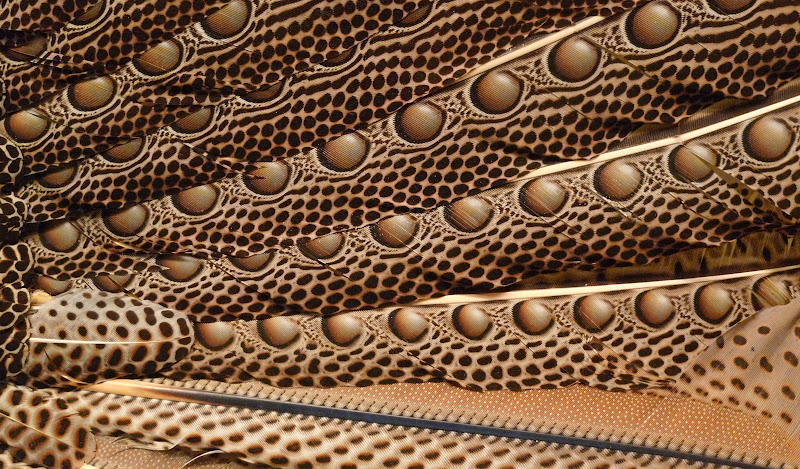
| Feathers from the Argusfasan (here and top) |


